
Garage Air Conditioner: Mini Split, Window or Portable?

A garage air conditioner can turn a sweltering garage into a comfortable gym, office or workshop on summer afternoons. Garages heat up fast: the big door faces the sun, the roof bakes, and a car parked after a drive adds even more heat. The right cooling setup depends on how often you use the space, how well it is insulated and how much you want to spend.
Last reviewed and updated: October 2, 2026. Written by Jeremy Jarvis.
Key takeaways
- A garage air conditioner works best in an insulated, sealed garage; otherwise most of the cooling escapes.
- Window and portable units are affordable for occasional use; a ductless mini split cools and heats efficiently all year.
- ENERGY STAR warns an oversized air conditioner costs more, wastes energy and does not cool better.
- HomeGuide puts a single-zone mini split at $2,500 to $6,000 installed.
This guide compares window, portable, through-the-wall and ductless mini split options, explains sizing, and covers insulation, costs, electrical needs and humidity. If you only need to clear hot air and fumes, a fan may be enough, so start with our garage ventilation fan guide.
Cooling vs ventilating
Before buying a garage air conditioner, decide what you need. Ventilation replaces hot, stale air with outdoor air. It helps when the outside air is cooler than the garage, such as in the evening, and it clears fumes from projects. However, it cannot cool the garage below the outdoor temperature.
Air conditioning removes heat and moisture, so it can make the garage cooler than outside. It costs more to buy and run, and it only works well in a closed, reasonably sealed space. Many garages benefit from both: a fan for fumes and mild days, and an air conditioner for hot afternoons.
Garage air conditioner options
Four main options suit garages. Each balances cost, efficiency and installation effort differently.

Free download: The Garage Makeover Planner
Our 12-page printable planner: garage profile, measurements and layout grid, declutter tracker, zone plan, floor chooser, door safety checks, budget worksheet and order of work.
| Option | Best for | Strengths | Watch-outs |
|---|---|---|---|
| Window unit | Occasional summer use | Affordable, easy to install | Needs a window; security and sealing |
| Portable unit | Small spaces, renters | No window install; movable | Less efficient; hot unit sits indoors |
| Through-the-wall unit | Garages without suitable windows | Permanent, secure | Requires cutting a wall opening |
| Ductless mini split | Year-round gyms, offices and workshops | Efficient cooling and heating, quiet | Highest upfront cost; pro install |
For a garage used a few weekends each summer, a window or through-the-wall unit is often enough. By contrast, a garage used daily all year usually justifies a mini split.
Window air conditioners
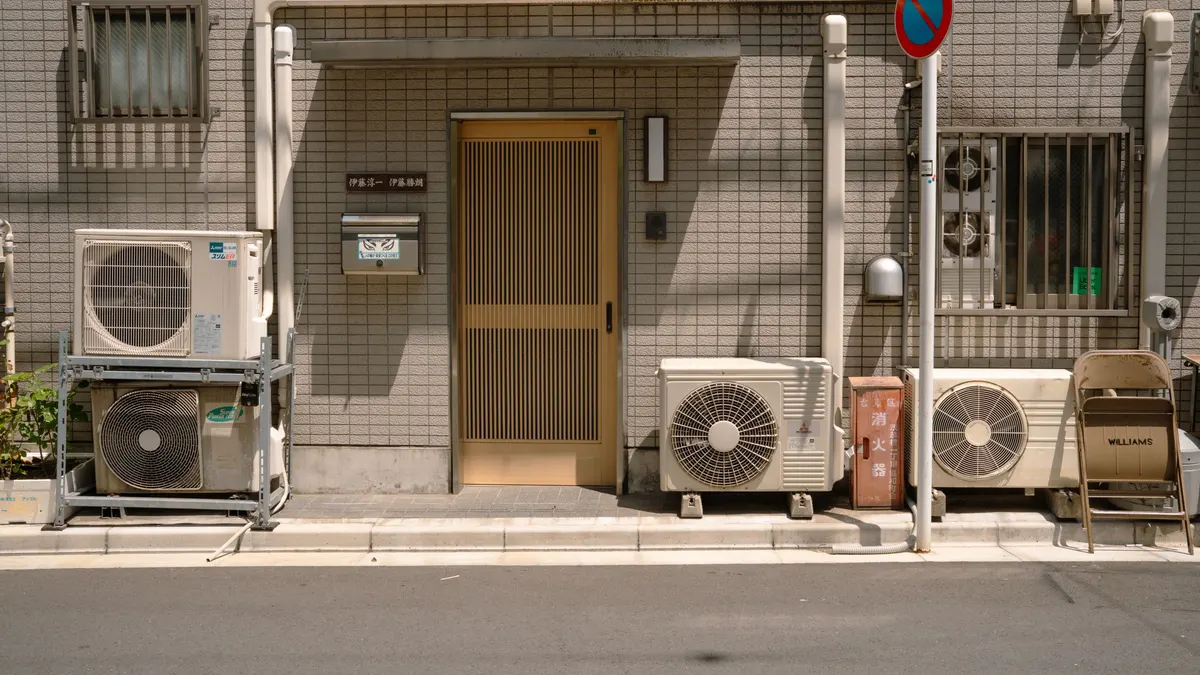
Window units are the most affordable way to cool a garage. They sit in a window opening, vent heat outdoors and plug into a standard outlet in many sizes. ENERGY STAR notes that most certified room air conditioners include variable speed technology that saves more energy and keeps rooms cool quietly.
Installation matters. ENERGY STAR says certified room units come with better materials and clearer instructions to improve sealing and insulation around the unit, so costly and uncomfortable air leaks are minimized. Some certified models have a U-shaped or saddle design that brackets the window rather than sitting on top of it, which can help with sealing and noise.
In a garage, security is a concern too. Use the unit’s brackets, add a window lock or bar, and consider removing the unit in the off-season.
Portable air conditioners
Portable units roll on casters and vent through a hose to a window or wall opening. They suit renters and small spaces where a window unit is not possible. Even so, they are usually less efficient than window units, because the hot machine sits inside the space you are cooling and the hose leaks heat.
If you choose one, keep the exhaust hose as short and straight as possible, seal the window kit well and close the garage door while it runs. Portable units also collect condensate, so check whether yours needs a drain hose or a tank that must be emptied.
Through-the-wall units
Through-the-wall air conditioners mount in a sleeve cut into an exterior wall. They work like window units but stay permanently in place and leave windows free. In a garage without a suitable window, they are a practical middle ground between a window unit and a mini split.
Installation requires cutting a framed opening and weatherproofing it, so many owners hire a contractor. Choose a sleeve and unit designed to work together, and check the circuit requirements before buying.
Ductless mini splits
A ductless mini split pairs an outdoor compressor with an indoor head mounted high on a wall or in the ceiling. A small line set connects them through the wall. ENERGY STAR describes mini split heat pumps as designed for homes or sections of homes that do not have ductwork, which makes them a natural fit for garages.
Efficiency is the big draw. ENERGY STAR notes that because they transfer rather than generate heat, certified mini splits use up to 60% less energy than standard home electric radiators. They also provide both heating and cooling from the same system, and in warmer months the system works in reverse for quiet, efficient air conditioning. As a result, a garage mini split is often the best choice for a space used year-round.
HomeGuide lists a single-zone mini split at $2,500 to $6,000 with installation, and a dual-zone system at $4,500 to $8,000. A standard 1- to 2-ton system, which is 12,000 to 24,000 BTUs, costs $3,500 to $8,000 with materials and labor.
Sizing a garage air conditioner
Bigger is not better. ENERGY STAR warns that an oversized air conditioner costs more to purchase, wastes energy and does not provide better cooling. An oversized unit cools the air quickly and shuts off before it removes much humidity, which leaves the garage cold and clammy.
The right size depends on the garage’s area, ceiling height, insulation, sun exposure, the door and your climate. Sizing charts for rooms assume insulated living spaces, so an uninsulated garage may need more capacity, while an insulated one may need less than you expect. For a mini split, a professional installer will calculate the load. For window units, start with the maker’s guidance and adjust for heavy sun or poor insulation.
Insulate and seal first
A garage air conditioner in an uninsulated garage fights a losing battle. Heat pours in through the roof, walls and the large door. Insulating and sealing first lets a smaller, cheaper unit keep the space comfortable.
Start with the garage door, which often faces the sun and has no insulation. Next, insulate the walls and ceiling, especially under a hot roof. Finally, replace worn seals around the door. Our garage insulation guide covers each step.

Costs to plan for
Window and portable units are the lowest upfront cost and usually DIY installs. Through-the-wall units cost more once you add the sleeve and wall work. Mini splits cost the most up front. HomeGuide lists ductless mini split installation at $2,500 to $15,000 or more overall, depending on the number of zones, the unit size and setup complexity, with multi-zone systems at $6,500 to $15,000 or more.
Style also affects price. HomeGuide lists wall-mounted single-zone units at $2,500 to $5,000, floor-mounted units at $3,000 to $5,000 per zone, ceiling cassettes at $3,500 to $6,000 per zone and concealed duct units at $4,000 to $7,500 per zone. For most garages, a wall-mounted head is the simplest and least expensive.
Electrical needs and condensate
Every air conditioner needs a suitable circuit. Small window units may plug into a standard outlet, while larger units and mini splits often need a dedicated circuit, sometimes at 240 volts. Check the unit’s requirements and have an electrician confirm your panel can support it.
Air conditioners also remove water from the air, and that condensate must go somewhere. Window units drip outside, portable units collect it in a tank or hose, and mini splits drain through a line to the outside or a pump. Plan the drain path so water does not pool on the garage floor.
Humidity and comfort
Air conditioners dehumidify as they cool, which is a big part of comfort in a humid climate. A correctly sized unit runs long enough to pull out moisture, while an oversized one does not. If the garage stays humid even when cool, a dedicated dehumidifier can help. Our garage dehumidifier guide explains how to size one.
Comfort also depends on air movement. A ceiling or wall fan spreads cool air and lets you set the thermostat a little higher while feeling just as comfortable.
Running a garage air conditioner efficiently
Small habits keep running costs down. Close the garage door before turning the unit on, and keep it closed while you work. Let a hot car cool outside for a while before parking it in a cooled garage. In addition, use a programmable or smart control so the garage is cool when you arrive rather than all day.
ENERGY STAR notes that many certified room units offer connected functionality and are smart-grid ready, potentially allowing you to take advantage of special energy bill savings programs some local utilities offer. Check whether your utility runs one. Finally, clean filters regularly, since garage dust clogs them quickly.
Garage mini split for year-round comfort
If you also need winter heat, a garage mini split can replace a separate heater. It heats efficiently in many climates and cools in summer, all from one wall-mounted head. That makes it especially attractive for garage gyms, offices and hobby spaces that you use every season. Compare it with dedicated heaters in our garage heater guide.
Placing the indoor and outdoor units
Placement affects how well any garage air conditioner performs. For a mini split, the indoor head usually goes high on a wall, where it can throw cool air across the garage without being blocked by shelves, racks or a raised garage door. Similarly, avoid placing it directly above the workbench if you sand or cut there, since dust clogs the filters quickly.
The outdoor unit needs clear airflow and a stable, level base, away from where cars or mowers might hit it. In snowy regions, installers often raise it on a stand. For window and through-the-wall units, choose a wall that is shaded in the afternoon if possible, because a unit in full sun works harder. In addition, keep the area around any unit clear, so air can move freely in and out.
Finally, think about noise. The quietest spot for an outdoor unit is away from bedroom windows, both yours and your neighbors’.
Garage air conditioner checklist
- Decide whether you need cooling, ventilation or both.
- Insulate the door, walls and ceiling and seal air leaks first.
- Choose window, portable, through-the-wall or mini split.
- Size the unit to the load; do not oversize.
- Confirm the circuit and panel capacity with an electrician.
- Plan the condensate drain path.
- Close the door and use smart controls to cut running costs.
Where to compare garage air conditioners
When you know the type and size you need, compare current ENERGY STAR window air conditioners, DIY-friendly mini split systems and through-the-wall units. Check cooling capacity, voltage and installation requirements on each listing. For more guides, visit the Garage Heating, Cooling and Insulation hub.
Frequently asked questions about garage air conditioners
What is the best way to air condition a garage?
For year-round use, a ductless mini split heat pump is usually the best option because it cools and heats efficiently. For occasional summer use, a window or through-the-wall unit is affordable. Insulate and seal the garage first so any unit can keep up.
Is a mini split worth it for a garage?
It is worth it for garages used often as a gym, office or workshop. HomeGuide lists single-zone mini splits at $2,500 to $6,000 installed, and ENERGY STAR notes certified mini splits use up to 60% less energy than standard home electric radiators.
What size air conditioner do I need for my garage?
Size depends on the garage’s area, insulation, sun exposure, door and climate. Avoid simply buying the biggest unit: ENERGY STAR notes an oversized air conditioner costs more to purchase, wastes energy and does not provide better cooling.
Can you put a window air conditioner in a garage?
Yes, if the garage has a suitable window and outlet. Seal around the unit, support it properly and secure it against break-ins. ENERGY STAR notes certified room units come with better materials and instructions to improve sealing around the unit.
Do portable air conditioners work in garages?
They can cool a small area for short periods, but they are usually less efficient than window units or mini splits. They need an exhaust hose to the outside, and the hot unit sits inside the space you are trying to cool.
Sources and how we researched this guide
This guide is research-based. We did not test air conditioners for this article; we compared cooling options and used ENERGY STAR guidance on room air conditioners and ductless heat pumps and HomeGuide’s mini split installation cost data. Mini splits and new circuits should be installed by licensed professionals. Found something out of date? Tell us and we will check it against the source.
- ENERGY STAR: Room air conditioners
- ENERGY STAR: Ductless heating and cooling
- HomeGuide: Mini split installation cost
Keep planning
- Garage Insulation: Walls, Ceiling, Door, Costs and R-Values
- Polyaspartic Floor Coating: Cost, Lifespan and vs Epoxy
- How to Insulate a Garage Door: Kits, Steps and Costs
- Garage Ventilation Fan: Types, Sizing and Placement Guide
Go deeper: Heating, Cooling & Insulation hub · Garage Heater Size Calculator · Garage Ventilation Calculator

Written by Jeremy Jarvis
Jeremy Jarvis is the founder and editor of Garage Playbook, where he builds research-based guides and free planning tools for garage doors, floors, storage, heating and cooling, and workshops. He sets the site's editorial standards, checks every guide against official sources such as federal safety standards, EPA and OSHA guidance and manufacturer documentation, and is responsible for corrections. Jeremy also founded Eco Nomad Travel, Mind Clarity Hub, SilkHarborTravel, WanderOza Travel, Freedom Road Living and PowerProof Home, and he is the author of books on clarity, focus and practical AI, including The Power of Clarity and Digital Clarity.